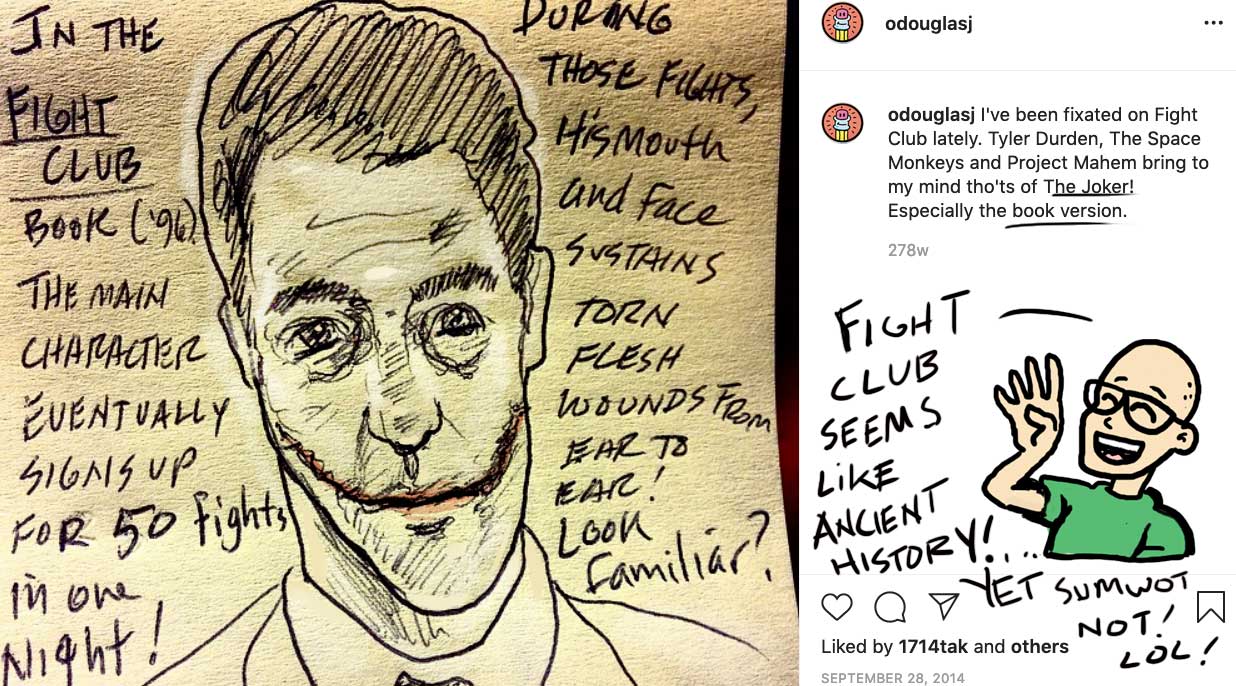
In the “Transgressive Lit” novel Fight Club (1996), the main character pushes himself to an extreme by signing up for fifty fights in one night. As the fights go on, his face takes heavy damage. By the end, it is no longer just a face. It is torn, stretched, and changed into something harder to recognize. When I sat down to sketch this moment, I expected to draw simple injury. Instead, I found myself drawing something that felt familiar.
The image I created reminded me of the wide, carved grin linked to The Joker. That connection led me to think more about the world of Fight Club. The presence of Tyler Durden, along with the behavior of the Space Monkeys and the structure of Project Mayhem, suggests a story that could easily fit into a Joker-style plot. The link is not exact, but it shares a similar tone and visual style built on chaos and change.
From an artistic point of view, the most important shift is how the face works in the image. The torn, stretched smile no longer shows normal emotion. It becomes a symbol. It looks like a mask that has been forced into place. In both Fight Club and Joker stories, identity starts to look less natural and more like something being performed. The character is not just feeling something different. He is showing it in a bold and unsettling way.
The body also becomes a way to send a message. In Fight Club, bruises and cuts show a need to feel something real in a world that feels empty. The damage becomes proof of being alive. For the Joker, the altered face shows a break from normal rules. In both cases, the body is used to express ideas about meaning, control, and belonging.
There is also a connection in how chaos is organized. Project Mayhem follows strict rules, even though it claims to fight against society. This is similar to many Joker stories, where groups carry out careful plans that look like pure disorder. Both examples show that even when people try to escape systems, they often build new ones. The image in the sketch reflects this mix of control and chaos.
Looking at the bigger picture, Fight Club comes from a time when many men felt lost in a world of office work, ads, and routine. They felt cut off from purpose and from each other. The story shows how that feeling can grow when life seems controlled and repetitive, with few real ways to connect.
By 2026, this feeling may be even stronger. Digital life fills everyday moments with screens, messages, and online images. People can seem connected, but still feel alone. Identity is often shaped through posts and profiles instead of real-life interaction. This can create pressure to appear perfect and make it harder to feel grounded.
In this setting, the image of the altered face takes on new meaning. The torn smile, whether seen through Fight Club or the Joker, becomes a symbol of the search for something real. The sketch is not just a drawing of a scene. It becomes a way to explore how people struggle with identity, control, and connection in a changing world.
BTW -- The term “Space Monkeys” from Fight Club is a cool coincidence because I designed a Space Monkey Puppet years ago named “Astro” for a kids program that is now available on sale!
I think of it as a “secret” Fight Club artifact.
Duuuude! $15 bucks is a steal for this puppet I designed! I've already been paid for my work & there's no royalties or anything for me, but REALLY if you know a Fight Club fan who's into the whole 'Space Monkey' thing, snatch it up! https://t.co/iMvOAI4p77 pic.twitter.com/qb7uVBP0Jg
— O. Douglas Jennings (@odouglasj) August 15, 2021


No comments:
Post a Comment